Providing for Old Age by Targeting Share Investments

Low interest? No, thanks!

Even when interest rates are low, investors can build up a pot of assets by themselves. Attractive financial instruments, such as shares, exchange-traded funds (ETFs), and other investment funds, are worth considering as alternatives to a call account and allow investors to benefit from the successes achieved by high-growth companies.

There is a need to raise awareness of shares and other investment formats

“Households will have more and safer opportunities to invest in capital markets and increase their wealth.”

Ursula von der Leyen
President of the European Commission


Despite a high savings rate, EU households invest little in shares. In Germany too, there are billions of euros sitting in money market accounts. Interest income is often low there, especially over the long term compared to shares.

In 2025, 14.1 million people in Germany were invested in shares, equity funds or equity-based ETFs. That is around one in five of the population over the age of 14─and 2 million more than in 2024.

There was significant growth among younger people in particular: 4.9 million people under the age of 40 held equity funds, ETFs, or shares in 2025. This figure has thus risen by 1.2 million since 2024.

Nevertheless, Germany still lags significantly behind countries such as the U.S., where more than half the population invests in shares, funds, or ETFs. Still, there is new momentum for such investments not only in Germany, but all over Europe, stimulated by the recent transformation of the EU’s Capital Market Union project towards a true Savings and Investments Union.

To ensure this positive trend continues, it is crucial—among other things—to strengthen financial literacy and make it easier to access equity investments.

Shares are profitable investments over the long term

Shares are securities that document ownership interests in a company, i.e. the owners of a share – the shareholders – hold an interest in the company’s share capital, either a percentage interest or an interest equal to the par value shown on the share. Shares are traded on securities exchanges. Here, too, supply and demand usually determine the value of a share.

Shares generally entail both opportunities and risks, as their quoted prices can rise or fall. Their price (or quoted price) is driven by expectations for a company’s profits. As investors have different expectations for companies’ future performance, supply and demand for a share rise and fall, causing share prices to rise and fall too.

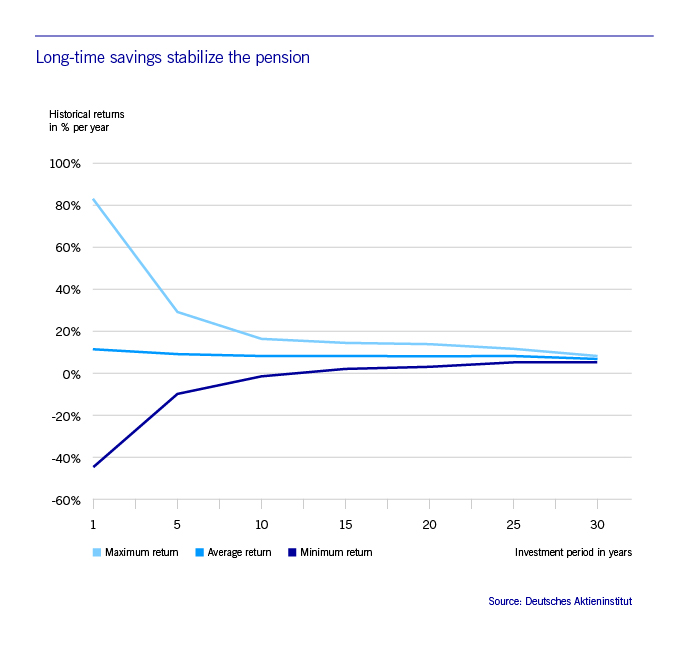
Although this means that share prices can fluctuate sharply over the short term, they have proven to be a profitable investment over the long term. Despite the financial crisis, investors in European shares earned an average return of 4.8 per cent per year between 2005 and 2015.

Those who invested in shares of the German stock index DAX during the past 50 years participated in the price development and dividends of the largest German stocks. For example, with an investment period of 20 years, an annual average return of 8.6 percent could be earned on the money invested. In the worst case, the annual return was 3.3 per cent, in the best case 15.2 per cent.
 

ETFs can help minimize your investment risk

In recent years, ETFs have been more successful worldwide than almost any other innovative financial instrument – both for professionals and for private investors. ETFs enable you to invest in hundreds of shares worldwide, in different sectors or currency areas at the same time. ETFs replicate the equity markets on which they are issued. By allocating (or spreading) investors’ money among different assets, ETFs enable investors to diversify their securities portfolio.

ETFs (exchange-traded funds)

… are fund units that investors can buy or sell on the stock market in the same way as shares. ETFs must meet two criteria:

1. Transparent portfolio: ETFs publish the composition of their portfolio on a daily basis. This gives investors a regular overview of the weighting of the individual shares in the portfolio based on the previous day’s closing prices.

2. Creation/redemption: ETFs have a “creation/redemption” mechanism that allows professional market participants to do a swap with the fund company at any time, exchanging baskets of shares composed of the same holdings for ETFs (and vice versa).


 

This reduces the risk of a loss, a risk an investor would enter into were they to invest all their money in just one share. Fluctuations in individual assets can be smoothed out: if the number of securities in the securities portfolio rises, the risk in the overall portfolio falls.

Diversification

Spreading and reducing risk by investing money in a number of different securities.

In a diversified securities portfolio, the overall risk is lower than the weighted average of the risks of all individual holdings. Securities funds are based on the principle of diversification.


STOXX Europe 600

Of the European indices, the STOXX® Europe 600 Index offers the broadest diversification. It comprises the 600 largest companies by market capitalization from 17 European countries, including the UK, Switzerland and Sweden. The index thus covers nearly 90 percent of the underlying investable market. Investors can invest in several ETFs based on this index.


From just €50.00 a month, ETFs are a worthwhile investment. Pension provision is becoming ever more important. For some time now, we have been seeing a sharp increase in the number of ETF investors in Europe: from 19 million in 2022 to 33 million in 2025.

Nearly half of European ETF growth was based on Deutsche Börse Group’s STOXX indices. Xetra is by far the largest ETF trading venue in Europe in terms of both trading volume and number of listed products. And a good two-thirds of all volumes come from outside Germany. 

Access to the world of stock markets – financial education must become part of general education

Deutsche Börse Group believes that financial knowledge impacts growth, employment and prosperity. It therefore supports financial education and the development of the equity culture through numerous initiatives:

  • Each year, some 50,000 visitors, many school pupils among them, experience the exchange’s trading floor live and free of charge.
  • Around 100 times a day, various TV stations report to the entire world from the Frankfurt trading floor – the only one of its kind in Europe.
  • Deutsche Börse offers knowledge of the financial market and a number of stock market products. On the Deutsche Börse websites, you can find information such as fact sheets, videos and webinars on capital market-related topics.

Deutsche Börse Group

Headquartered in Frankfurt/Main, Deutsche Börse Group is one of the largest exchange organizations worldwide. It operates markets that provide integrity, transparency as well as security for investors wishing to invest capital and for issuers wishing to raise capital. On these markets, institutional traders buy and sell shares, derivatives and other financial instruments in accordance with clear rules and under strict supervision.

Today, Deutsche Börse Group is more than just a trading venue or exchange – it is a provider of financial market infrastructure. Its business areas cover the entire financial market transaction process chain. This includes the provision of indices, data, and analytical solutions as well as admission, trading and clearing. Additionally, it comprises services for funds, the settlement and custody of financial instruments as well as the management of collateral and liquidity. As a technology company, the Group develops state-of-the-art IT solutions and offers IT systems all over the world.