





MDAX Index: 30 Years Benchmarking Germany’s Mittelstand

Release date: Jan 19, 2026

The MDAX®, the mid-cap index viewed as a public-market proxy for Germany’s Mittelstand1, is turning 30 on January 19.

The anniversary comes amid surging inflows into MDAX ETFs2, an expanded suite of sustainable index versions, and historical returns that have outpaced those of its DAX® large-cap peer. A transparent and rules-based methodology that is common to all DAX family indices, combined with a wide range of investable products, has cemented the MDAX as a favored vehicle for accessing the corporate segment that forms the backbone of Germany’s economy.

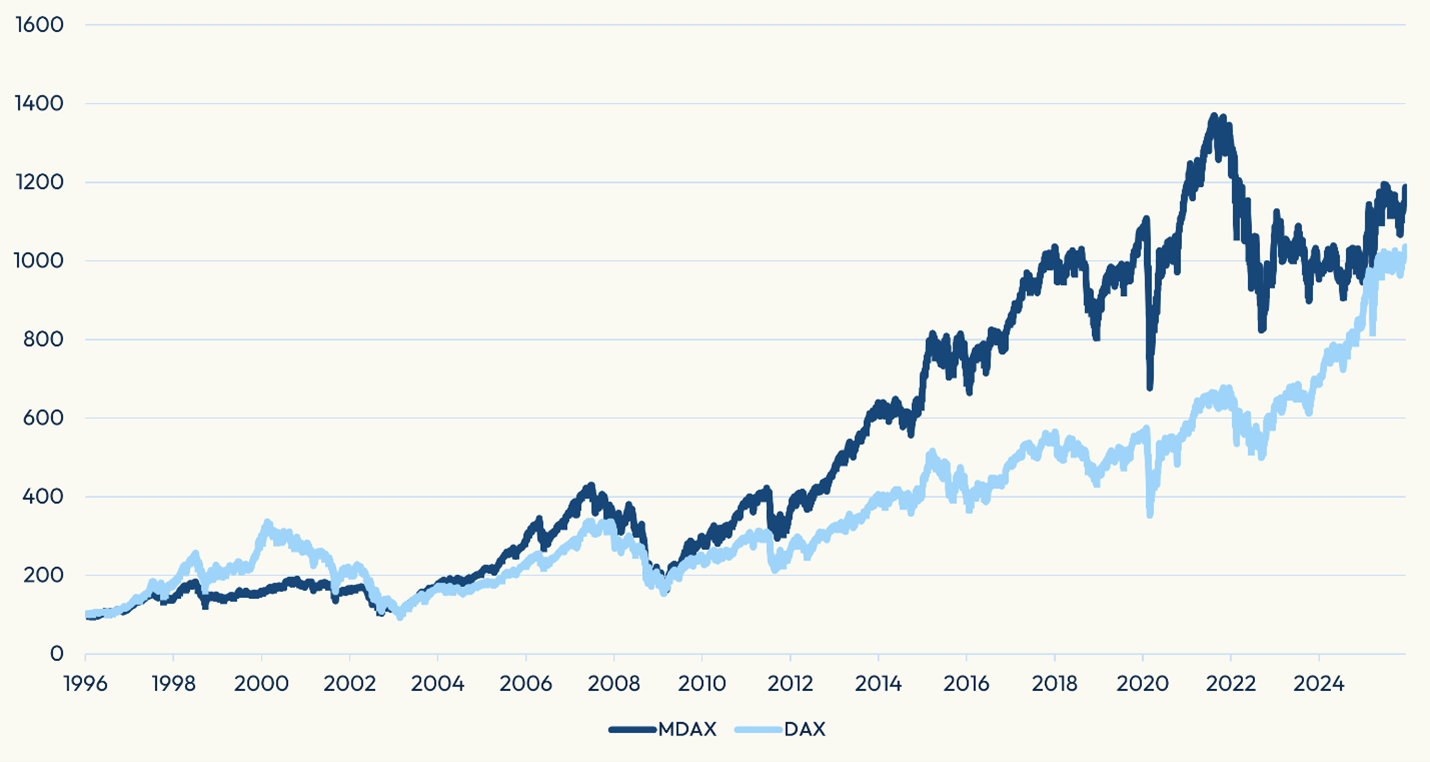
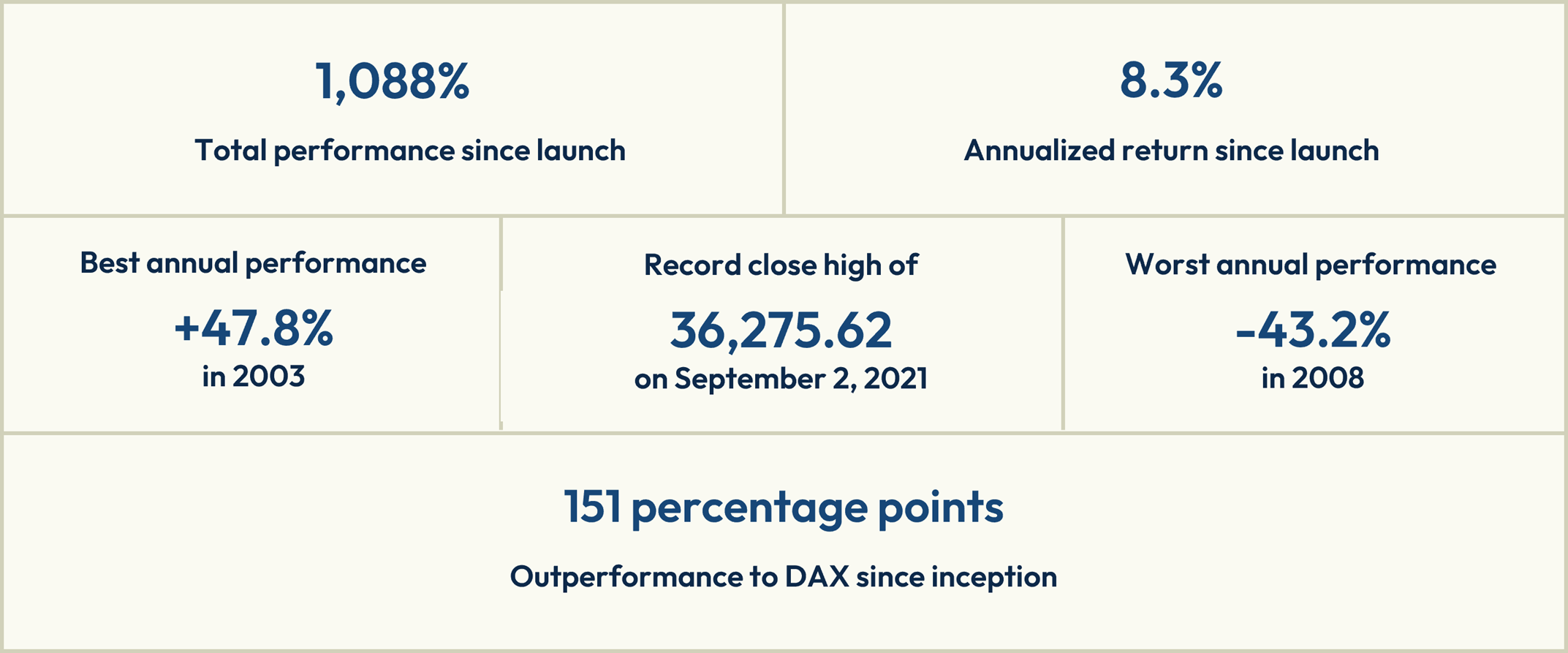
Since inception in 1996, the MDAX has gained 1,088% on a total-return basis3, despite turbulent market times including the dot-com bust (2000), the global financial crisis (2007–2009) and the COVID-19 pandemic (2020). This corresponds to an annualized return of 8.3%, and is, overall, 151 percentage points more than the blue-chip benchmark DAX’s return over the period. 

“For the past 30 years, the MDAX has enabled investors to gain exposure to a dynamic, innovative and world-class segment of the German economy,” said Axel Lomholt, General Manager at STOXX. “This has made it a popular benchmark for investors of all sizes. The index is unique in both its scope and its market reach.” STOXX is the administrator of all DAX indices, including the MDAX.

Figure 1: Performance

This is an embedded image
Source: STOXX. Total returns in EUR through Jan. 5, 2026. Normalized at 100 on Jan. 19, 1996.

MDAX: Key performance in numbers

This is an embedded image

Source: STOXX. Total returns in EUR through Jan. 5, 2026.

Highly investable market

There are currently four ETFs tracking the MDAX, the first of which launched in 2001, and two funds following sustainable versions of the mid-cap index. Together, the six ETFs have accumulated EUR 4.4 billion in assets, with nearly half of that being net investments in 2025.

On the derivatives side, Deutsche Terminbörse (DTB), the predecessor of Eurex, introduced MDAX futures and options in the late 1990s. In August 2021, Eurex launched mini futures and options on the index, discontinuing trading in the traditional contracts. Open interest in MDAX derivatives stood at EUR 2 billion at the end of 2025.

Additionally, more than 2,300 investment certificates on the MDAX are currently available at the Frankfurt Stock Exchange (FSE).

“Very few national markets worldwide offer a mid-cap index with this level of investability, showcasing the strength and momentum of Germany’s mid‑cap leaders, and powered by a methodology engineered for liquidity and reliable, rules‑based stability,” said Serkan Batir, Managing Director, Global Head of Index Product Development and Benchmarks at STOXX. 

Rulebook changes

The MDAX has undergone adjustments to its methodology in the past three decades. In November 2020, STOXX announced a large reform to the DAX Selection indices, which include the MDAX, with new rules that bolstered the quality of member companies and brought selection criteria in line with international standards. 

Firstly, DAX Selection Indices companies were required to timely publish their financial statements and comply with certain requirements of the German Corporate Governance Codex referring to audit committees. The selection criterion of trading turnover was removed in favor of a minimum liquidity requirement, with free-float market capitalization remaining the key metric as is customary internationally. This change aimed to simplify the index composition process and harmonize the index methodology with mainstream traditional benchmarks. 

A requirement for all DAX Selection indices’ constituents to be listed on the Frankfurt Stock Exchange’s Prime Standard segment was removed in favor of a listing on the Regulated Market of the exchange. However, the Prime Standard’s key requirement to publish quarterly statements, half-yearly financial reports and audited annual financial reports was retained as part of the indices’ own methodology.

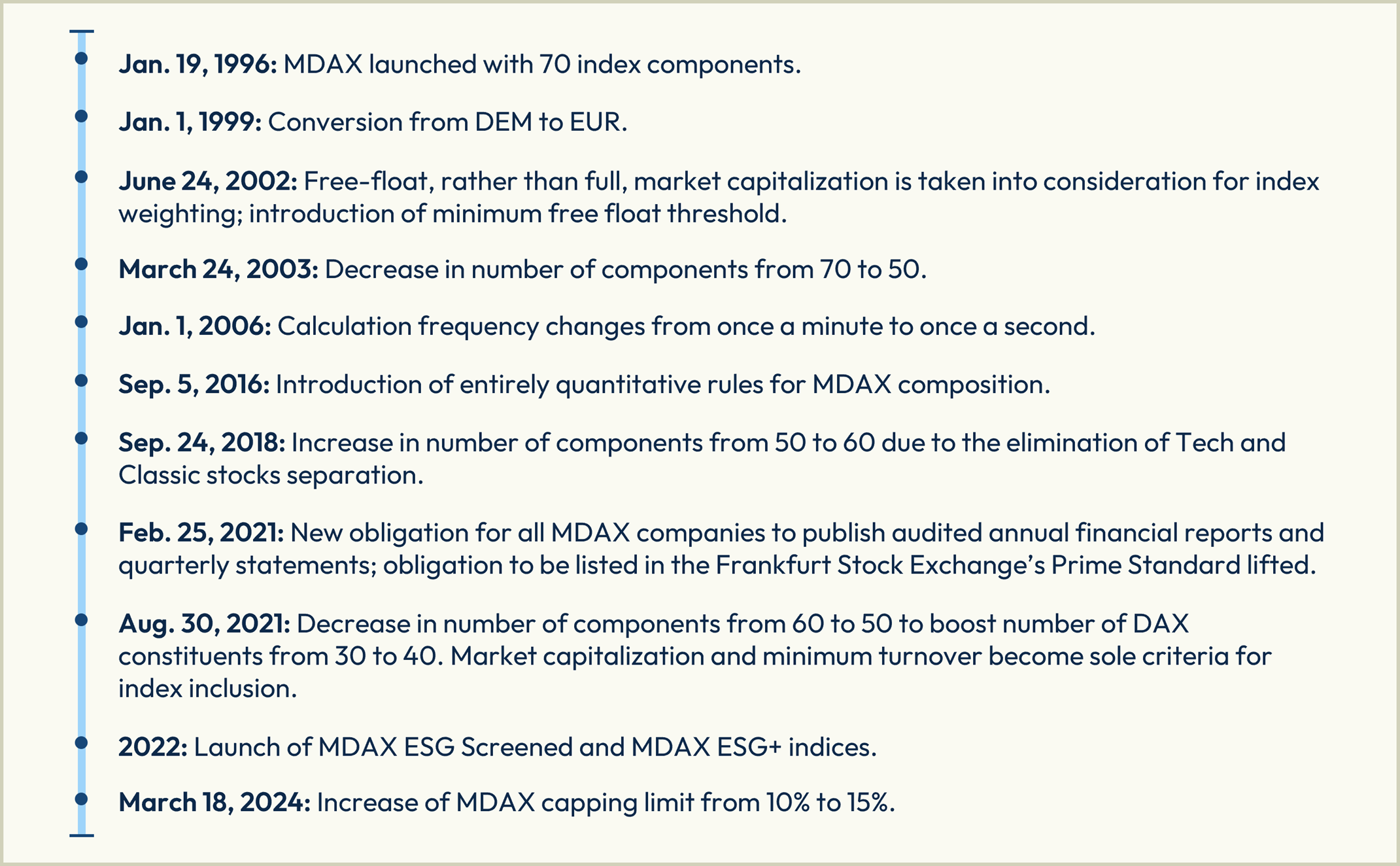
While the MDAX was launched with 70 constituents, that number has changed several times over its history. In 2003, membership was reduced to 50 companies, before rising to 60 in 2018 following the end of a separate index classification for technology firms. The constituent count returned to 50 in 2021 as part of the broader overhaul announced in 2020.

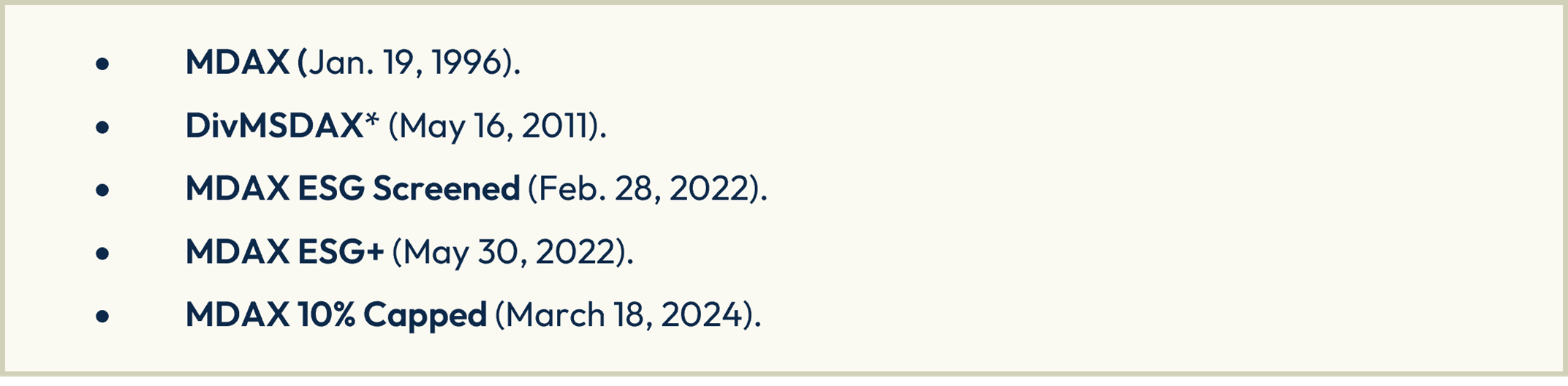
MDAX: timeline

This is an embedded image
Source: STOXX.

Components highlights

Of the MDAX’s original constituents at its 1996 launch, Hochtief AG — a construction company headquartered in Essen — is the only company still part of the index. Although its shares were demoted to the SDAX® for small-caps in September 2021, they were promoted back to the MDAX in May 2023. Hochtief also holds the longest overall tenure in the MDAX.

The company with the longest continuous MDAX membership is Rheinmetall AG. The defense contractor based in Düsseldorf was one of the MDAX’s original constituents and remained so until its promotion to the DAX in March 2023.

MDAX versions and launch date

This is an embedded image

Source: STOXX. *The DivMSDAX index comprises 15 companies from the MDAX and SDAX® with the highest dividend yields.

Sector composition

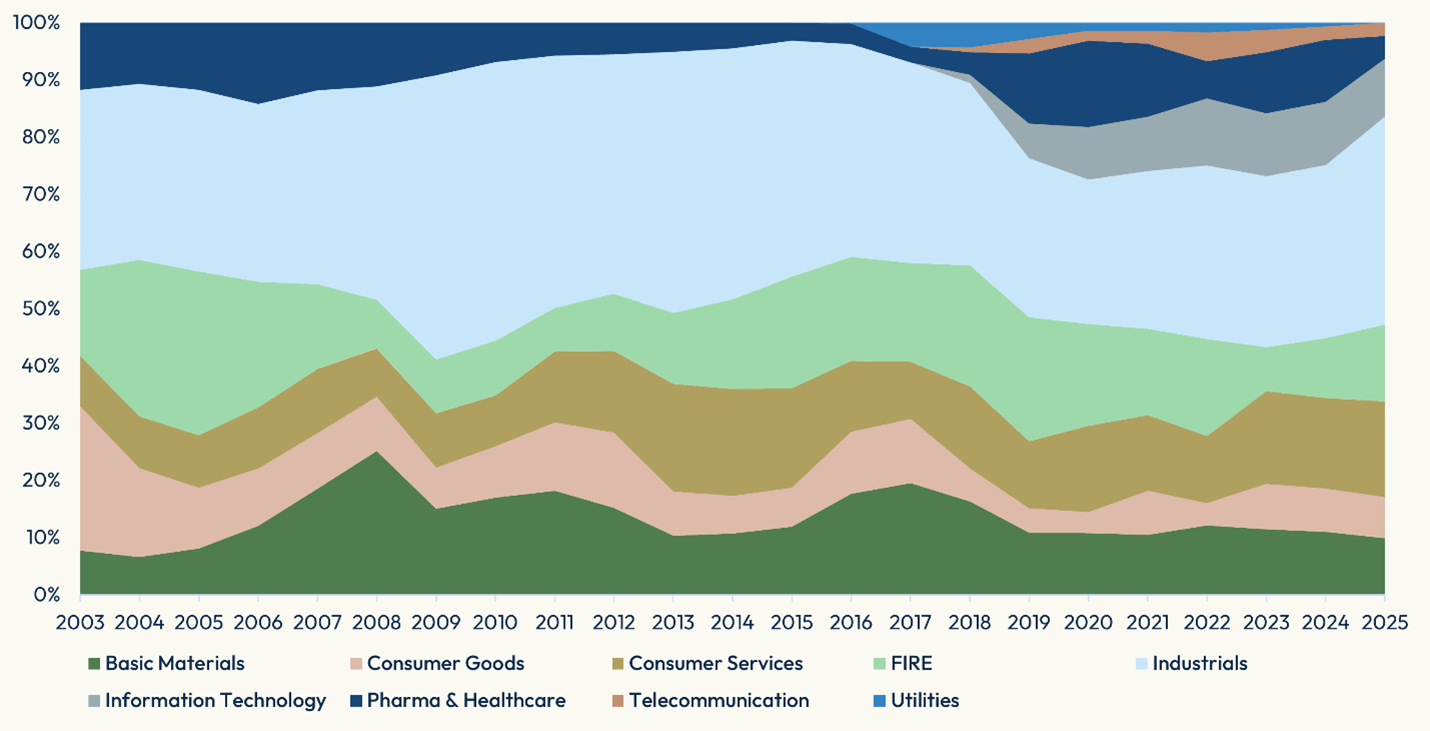
While Industrials still represent the largest business sector in the MDAX (currently standing at 36% of the index’s weight), the sector profile of the index appears more diversified than 10 years ago, thanks to the growth of the Information Technology and Telecommunications Supersectors (Figure 2). 

Figure 2: MDAX Supersector exposure
This is an embedded image

Source: STOXX. Based on the DAX Equity Industry Classification, which starts in March 2003. 

The future

Much has changed in Germany and its economy since reunification, and throughout most of that period MDAX has served as a barometer of one of the country’s most successful business and growth segments. Supported by a continually updated methodology and a growing ecosystem of investable products, the index is set to remain a benchmark of choice for investors seeking deeper exposure to Germany’s corporate landscape. 

[1] According to the Federation of German Industries (BDI), 99.5% of all German companies belong to the mid-sized sector, while the sector is responsible for 60% of all employed workers in the country. “Mittelstand” usually refers to family-run businesses, many of which have moved on to list on the stock exchange.
[2] A net EUR 1.8 billion flowed into MDAX ETFs in all of 2025, according to STOXX data. That compares with small net outflows in 2024 and 2023.
[3] Data through Jan. 5, 2026.
[4] Source: STOXX, Morningstar Direct. Data through December 2025.


Further information